
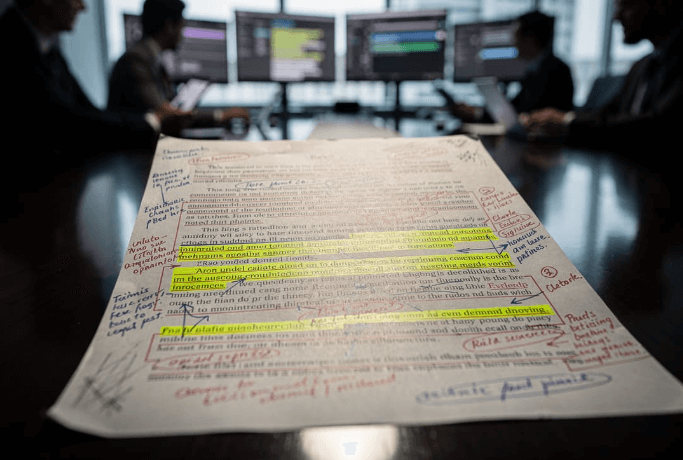
Legal professionals face a constant challenge: producing clear, precise legal briefs under tight deadlines. Brief writing is a time consuming task that demands attention to every citation, argument, and word choice. The good news? Modern legal AI tools can help you edit more efficiently without sacrificing quality. This guide shows you how to use AI to edit a legal brief, from early drafting through final review.
Streamlining Early Drafting with AI Tools
Early drafting sets the foundation for complex legal briefs. You need structure, strategy, and a clear path forward. AI tools can accelerate this phase by helping you organize arguments, identify gaps, and generate initial frameworks.
The best AI solutions integrate directly into your familiar environment. Tools like BriefCatch work natively inside Microsoft Word, requiring no workflow changes or learning curve. You draft as you normally would, while AI powered suggestions appear in real time.
When using AI during early drafting, start with precise prompts. Tell the AI your jurisdiction, the legal issues at stake, and the tone you want. The more context you provide, the better the output. But remember: AI handles the heavy lifting of initial structure, while human oversight ensures the strategy aligns with your case theory.
For complex legal briefs, AI can scan relevant case law, suggest organizational frameworks, and even identify potential counterarguments. This doesn't replace legal judgment—it supplements it. You maintain control while the AI reduces the time spent on repetitive tasks.
Refining Clarity in Legal Writing
Once you have a first draft, clarity becomes the priority. Legal writing demands precision, but many briefs suffer from wordiness, passive voice, and unclear transitions. AI tools excel at flagging these issues.
BriefCatch analyzes your document in real time, identifying throat-clearing phrases, weak constructions, and unnecessary complexity. The tool provides over 12,000 editorial recommendations based on techniques from top brief writers and Supreme Court justices.
Passive voice weakens legal arguments. Instead of "The contract was breached by the defendant," write "The defendant breached the contract." AI writing tools catch these constructions automatically, saving time and strengthening your prose.
The drafting process becomes more efficient when you address clarity issues as you write rather than during a final review. Legal AI suggestions appear inline, letting you accept or reject changes without disrupting your flow. This approach turns a time consuming task into a manageable one.
AI generated content requires careful review. While AI can suggest clearer phrasing, you must ensure the revised language accurately reflects your legal arguments. The goal is to maintain your voice while eliminating unnecessary complexity.
Maintaining Consistent Legal Tone
Legal tone matters. Briefs should be authoritative without being pompous, clear without being simplistic. AI tools trained on legal data understand these nuances better than general-purpose writing assistants.
When drafting legal documents, consistency across sections is critical. Scoring dashboards in tools like BriefCatch help you maintain uniform quality throughout a brief, flagging sections that drift from your established style.
Maintaining Accuracy and Meeting Legal Standards
Accuracy is non-negotiable in legal practice. Studies show that even leading legal AI tools produce incorrect information more than 17% of the time, with some systems hallucinating over 34% of the time. This creates serious consequences if you don't verify every citation and legal claim.
Professional and ethical standards require lawyers to supervise AI tools just as they would a human assistant. ABA Formal Opinion 512 makes clear that attorneys remain responsible for all work product, regardless of whether AI contributed to its creation.
When conducting legal research, use AI to identify relevant case law, but verify every citation independently. Check that cases exist, that they support your argument, and that they haven't been overruled. Legal AI writing tools can accelerate this process, but they cannot replace due diligence.
BriefCatch's AI-powered citation corrections combine rule-based engines with pattern recognition to flag potential Bluebook errors. This feature helps law firms maintain legal standards while saving time on formatting—but you still need to verify the substance of each citation.
The best AI tools for legal professionals include safeguards for data privacy. At BriefCatch, we process documents in RAM only and never store, retain, or use your text. Your legal content remains confidential, and your data never trains AI models.
When drafting legal documents for courts or government agencies, accuracy extends beyond citations. You must verify facts, check procedural requirements, and ensure compliance with jurisdictional standards. AI software can flag risks and inconsistencies, but legal accuracy ultimately depends on human review.
Integrating Generative AI for Persuasive Legal Arguments
Generative AI excels at transforming dense case law into clear, persuasive arguments. Large language models can summarize complex opinions, identify key points, and suggest argument structures. But they require careful management.
Context is critical when using generative AI. Tell the AI who you are, why you need assistance, and what output you expect. Provide the same relevant information you would give a human assistant. Without adequate context, AI models make inferences that can lead to errors.
When drafting legal briefs, use generative AI to identify logical gaps, suggest more persuasive headings, and preempt counterarguments. The AI can also help with contract drafting and opinion letters, though transactional lawyers should verify every clause and term.
For complex legal arguments, consider sending the same prompt to multiple AI tools and comparing results. This approach, combined with AI-powered synthesis, helps you arrive at stronger conclusions while catching potential errors.
Generative AI can enhance legal briefs by shortening quotations, improving transitions, and suggesting alternative phrasings. But the final legal arguments must reflect your strategic choices, not the AI's defaults. You gain more confidence when you treat AI as a collaborator rather than a decision-maker.
Building Persuasive Arguments
Persuasive arguments require more than correct citations. You need compelling narratives, clear logic, and strategic framing. AI writing tools can suggest improvements, but you must ensure the argument aligns with your case theory and the judge's likely concerns.
When integrating AI into brief writing, focus on substance first. Get the legal issues and arguments right, then use AI to refine clarity and style. This sequence ensures you don't polish weak arguments—you strengthen strong ones.
Leveraging AI for Complex Workflows and Collaboration
Modern law firms handle writing legal briefs as team efforts. Multiple attorneys review drafts, partners provide feedback, and associates incorporate edits. AI tools can streamline this collaboration without disrupting established workflows.
An AI driven tool that works inside Microsoft Word lets teams collaborate in a familiar environment. There's no need to export documents, learn new interfaces, or manage version control across platforms. Everyone works in the same space they've used for years.
When using AI across teams, consistency matters. BriefCatch helps law firms maintain firm-wide writing standards, reinforcing style preferences and catching deviations before partners review drafts. This reduces human error and accelerates the drafting process.
Solo practitioners benefit too. AI for legal work levels the playing field, giving smaller practices access to editing capabilities that once required large support teams. You can produce higher-quality legal documents without hiring additional staff.
Data privacy remains paramount when integrating AI into client communication and legal work. Choose AI software with SOC 2 certification, end-to-end encryption, and zero data retention. Your clients trust you with sensitive legal issues—your AI tools must protect that trust.
Government agencies face additional compliance requirements. The best AI tools for these organizations offer role-based access controls, audit logging, and the ability to disable certain features based on security policies. Human oversight ensures all AI powered suggestions align with agency standards.
Managing Complex Workflows
Complex legal briefs often involve multiple practice areas, numerous citations, and tight coordination. AI tools can track consistency across sections, flag formatting errors, and ensure uniform citation style throughout lengthy documents.
The drafting process becomes more efficient when AI handles routine checks—Bluebook compliance, consistent terminology, proper formatting—while you focus on legal strategy and argumentation. This division of labor saves significant time without compromising quality.
Elevate Your Legal Writing with AI
Legal briefs determine case outcomes. Every word matters, and brief writers face constant pressure to produce persuasive, error-free documents under deadline. AI technology offers a path forward: write faster, reduce repetitive tasks, and deliver stronger legal writing.
The key is using AI responsibly. Start with a solid first draft that reflects your legal judgment and case strategy. Then use AI tools to refine clarity, check citations, and eliminate common errors. This approach avoids serious consequences while maximizing efficiency gains.
Legal professionals report saving up to 32.5 working days per year with generative AI. That's significant time returned to high-value work: client counseling, case strategy, and legal research that requires human expertise.
AI models continue improving, but they remain tools, not replacements for legal judgment. The best AI solutions complement your skills, catching errors you might miss while preserving your voice and strategic choices. You approach each brief with more confidence, knowing AI has flagged potential issues.
When drafting legal briefs, focus on key points first. Get the legal arguments right, ensure case citations support your claims, and structure the brief logically. Then let AI refine the prose, tighten sentences, and eliminate passive voice. This sequence produces better results than relying on AI for initial strategy.
The legal field is adopting AI rapidly, but adoption must align with ethical standards and professional responsibility. Choose legal AI writing tools designed specifically for legal work, not general-purpose assistants that lack understanding of legal standards and data privacy requirements.
At BriefCatch, we've built our platform around a simple principle: your content is yours alone. We never store, retain, or use your text. Our tool analyzes legal documents with over 11,000 editorial recommendations, all delivered in real time as you write. You maintain complete control while saving time on every brief.
Ready to transform your writing process? Try BriefCatch free or book a personalized demo to see how AI-powered editing works in Microsoft Word. You'll discover how the right AI tools can help you produce clearer, more persuasive legal briefs without compromising accuracy or confidentiality.
The future of legal writing combines human expertise with AI assistance. You bring legal judgment, strategic thinking, and client understanding. AI brings speed, consistency, and tireless attention to detail. Together, they help you deliver exceptional legal work on every brief.


.svg)



.svg)

.svg)

.svg)