
Most lawyers treat the statement of facts as background. Get the story out of the way, then get to the real work in the argument section. But judges often form their first impression of the case right there in the facts.
A stronger facts section is neither a flat chronology nor an argument in disguise. It is a selected, organized, and credible narrative that sets up everything after it.
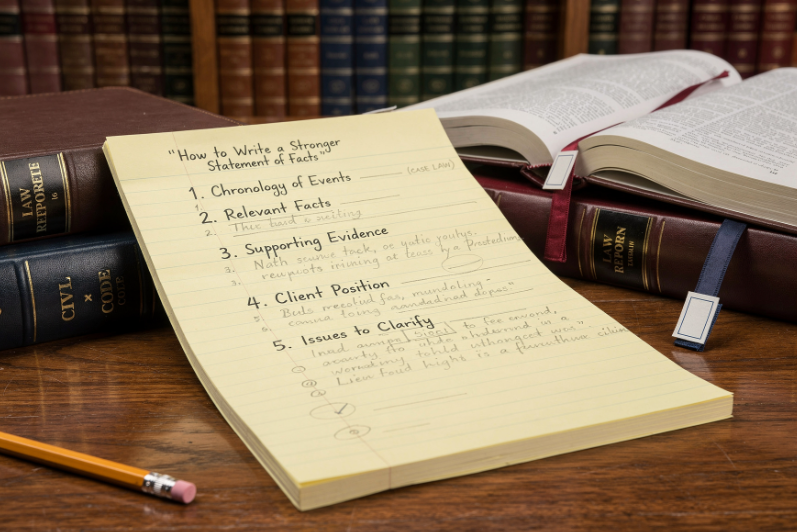
This post covers how to choose facts, structure them, control tone, sharpen sentences, avoid common mistakes, and revise before filing. Learning how to write a stronger statement of facts starts with understanding why it carries so much weight.
Why Does the Statement of Facts Matter So Much?
The statement of facts matters because it gives the court the context, chronology, and credibility cues that shape how the legal argument will be received. A judge reads it first and comes to the case fresh, with no history of the parties or the dispute. The impression it leaves colors every argument that follows.
This is where you establish the foundation for every legal argument that follows. A strong statement provides context, influences how the court views the case, and sets the stage for a good argument.
The facts section as persuasion by context
Framing shapes credibility, sympathy, and the perceived legal consequences. A good facts section makes your argument feel inevitable rather than forced. Every word can be accurate while your choices about selection and order still guide the reader.
The judge's need for a usable narrative
Judges need a story they can follow, not a pile of dates, names, and docket entries. Lead with a narrative line that shows how the parties reached an impasse. When you dump unfiltered record material, you make the court work harder and lose the chance to control the frame.
What Should a Strong Statement of Facts Accomplish?
A strong statement of facts should give the court a clear, credible, and strategically organized account that supports the legal argument without openly arguing it. It orients the reader to the parties, the dispute, the timeline, and the stakes. And it stays accurate throughout.
Clarity
The reader should finish the section understanding what the case is about. Present the details in chronological order so the reader does not get lost in a jumble of dates and events.
Credibility
Almost every sentence should be followed by a citation to the specific page of the record. This is not just a technical requirement. When you cite facts with precision, you show the court your narrative is grounded in the record, not in wishful thinking.
Strategic relevance
Distinguish legally material facts from distracting background. Ask what specific legal issues arose and what key facts support your position, then keep the focus there.
Narrative control
Build momentum without overstating or arguing. And anticipate unfavorable facts instead of hiding them, because rarely does every fact favor the prevailing party.
How Do You Choose Which Facts to Include?
Choose facts by asking whether each one helps the court understand the dispute, apply the governing law, trust your narrative, or resolve a key issue. If a fact does none of those things, it probably does not belong. Selection is where much of the persuasion happens.
Start with the legal standard
Begin with the elements, standards, or issues the court must decide. Include facts that affect those issues directly or explain why they matter. In an employment dispute, facts about the decisionmaker, the timeline, notice, performance history, and stated reasons usually matter more than office background.
Separate material facts from background facts
Some background helps orient the reader. Most does not. Cut facts that are interesting, repetitive, or emotionally satisfying but do no legal work.
Handle bad facts early and fairly
Include enough unfavorable facts to preserve credibility and avoid surprise. If you leave out a damaging fact, opposing counsel will raise it anyway, and you lose the chance to frame it.
Cut facts that do no work
When you introduce your client, handpick nouns and verbs that put your position in the best light. Subtle choices here make your client relatable while subordinating bad facts to weaker parts of the sentences.
How Should You Organize the Facts?
Organize the facts in the structure that makes the dispute easiest to understand. That usually means chronology, but use thematic or hybrid organization when it better highlights the legally important story. The right structure depends on the record.
Chronological structure
Chronology is the default because it is intuitive and reduces confusion. It answers "what happened when" and keeps the reader from getting lost.
Thematic structure
When chronology alone obscures the key point, group facts by theme. This helps in complex records where events overlap or span years.
Hybrid structure
A short overview followed by chronological or issue-focused subsections often works best. Give the reader the shape of the case, then fill in the sequence.
Fact subheadings that guide the reader
Craft active-voice headings for the statement of facts, perhaps in the present tense. This keeps the reader engaged and makes the facts feel immediate. Keep the headings informative, not argumentative, and avoid starting so early in the timeline that you bury the central dispute.
How Can You Write Facts Persuasively Without Arguing?
You can write facts persuasively without arguing by presenting concrete, well-ordered details that lead the reader toward your position without relying on conclusions or advocacy labels. Persuasion comes from selection, sequencing, precision, and contrast. The moment a facts section sounds like argument, a judge dismisses it as spin.
Show rather than characterize
Let choice details speak for themselves. Avoid labels like "clearly," "obviously," "baseless," or "manufactured" unless you are quoting or the law requires it. Those words carry no meaning and read as filler.
Use precise verbs
Use active voice to keep clarity and a persuasive tone. Instead of "The contract was breached by the defendant," write "The defendant breached the contract." The second version is shorter, clearer, and more forceful.
Let chronology reveal causation
Order events so cause and effect emerge on their own. Let documents, admissions, dates, and actions carry the weight instead of your adjectives.
Reserve argument for the argument section
Persuasive neutrality builds trust. Lord Denning conveyed the essence of expert testimony through select quoting, indirect paraphrase, and context cues, and there was nothing unfair or subjective about it. Save the conclusions for where they belong.
How to Write a Stronger Statement of Facts Under Deadline Pressure
When time is short, a simple workflow keeps the section focused. Knowing how to write a stronger statement of facts quickly is mostly about sequence.
Define the factual theory
Write one sentence that captures your factual story. If you cannot state it plainly, you are not ready to draft.
Create a source-backed fact list
Build a fact list tied to record citations or source materials. Some lawyers draft the argument first, then pull the facts the argument needs.
Draft the roadmap first
Sketch a short roadmap before writing paragraphs. Use topic sentences to orient the reader at the start of each section.
Revise for clarity and flow
Revise for chronology, transitions, record support, and unnecessary detail. Tools like BriefCatch help you tighten clarity, concision, and tone inside Microsoft Word when the clock is running.
What Sentence-Level Techniques Make the Facts Clearer?
Sentence-level clarity comes from strong subjects, precise verbs, focused paragraphs, useful transitions, and sentences that guide the reader through the sequence. Small choices add up across a section.
Strong subjects and verbs
Put the actor and the action close together. Use the subject-verb-object pattern so the reader sees who did what.
Controlled sentence length
Break up longer sentences into shorter, punchier ones. Use short sentences for pivotal facts and slightly longer ones for background.
Focused paragraphs
Keep each paragraph on one development. No paragraph should run longer than a page.
Useful transitions
Use transitions to show time, contrast, and causation. And vary them so you do not lean on the same connector over and over.
Plain language over legalese
Favor short words like "can" and "but" to take the reader on a smoother, faster ride. Avoid nominalizations and legalese that slow the pace.
How Should You Handle Bad Facts?
Handle bad facts by acknowledging them fairly, placing them in accurate context, and showing why they do not defeat your theory of the case. Candor is not optional. Judges and clerks usually catch what you leave out.
Disclose before the opponent does
Never let the other side introduce your bad facts first. Disclosing them yourself lets you control how they appear.
Add context without making excuses
Nod to bad facts and then neutralize them by controlling how they appear in context. One technique is to embed unfavorable facts in "Although" clauses and then turn attention elsewhere. If a client missed a deadline, explain the timing, notice, and communications accurately without overexplaining.
Use neutral language
Avoid sounding defensive. Do not attack opposing counsel or the lower court. Show why a statement is wrong and let the court draw the conclusion.
Connect back to materiality
Distinguish harmful facts from merely inconvenient ones. Concede the core fact while minimizing its length, importance, and visibility in the larger narrative.
What Common Mistakes Weaken a Statement of Facts?
The most common mistakes are overloading the section with irrelevant detail, arguing instead of narrating, obscuring chronology, mishandling bad facts, and failing to support key assertions. Each one costs you credibility.
Fact dumping
Too much procedural clutter or background bogs the reader down. Include only the procedural history needed to understand the posture.
Argumentative tone
Overusing adjectives and adverbs turns narrative into spin. A witness-by-witness summary reads the same way, since cautious regurgitation is no longer writing or advocating. It is rote transcribing.
Missing record support
Every important assertion needs a citation. Facts outside the record can get your statement struck.
Unclear party labels
Unexplained acronyms and short-form references stop readers who are not immersed in the case. Keep names and terms consistent.
Poor chronology
Starting with irrelevant background or scrambling the timeline confuses the reader. And repeating facts later in the argument without purpose wastes space.
How Do You Revise a Statement of Facts Before Filing?
Revise by testing the narrative flow, verifying record support, cutting clutter, replacing conclusions with concrete details, and polishing the prose. A short checklist catches most problems.
Test the paragraph sequence
Read only the first sentence of each paragraph. If the story still holds together, your flow works. Check that each paragraph advances the narrative.
Verify record support
Confirm that every important factual assertion has a citation to the record. This is the fastest way to protect your credibility.
Cut repetition
Remove duplicative dates, names, and procedural details. If a fact appears twice for no reason, delete one.
Replace conclusions with facts
Swap characterizations for concrete details. Show the fact instead of labeling it.
Polish for style and readability
Reading your document aloud catches problems that silent reading misses. When you stumble over a sentence, your readers will too. BriefCatch flags unclear phrasing, wordiness, and tone so you can tighten the section fast.
Frequently Asked Questions
How long should a statement of facts be?
Long enough to present the material facts clearly and fairly, but no longer than needed to support the issues the court must decide. Judges prefer short, focused briefs. Cut anything that does not advance the story or the argument.
Should a statement of facts include procedural history?
Include only the procedural history needed to orient the court or explain the posture of the issue. Do not turn the facts section into a docket summary. Some courts require a separate statement of the case for procedural background.
Can you use headings in a statement of facts?
Yes. Concise, informative headings guide the reader, especially in longer or complex briefs. Keep them descriptive rather than argumentative.
Should facts be written in past tense?
Most case facts belong in the past tense. Legal rules, ongoing conditions, and current procedural posture may call for present tense. Active-voice headings sometimes read well in the present tense too.
Is it acceptable to tell a story in a legal brief?
Yes, as long as the story is accurate, record-supported, restrained, and tied to the legal issues. A good facts section has the attributes of a narrative. It just never sacrifices accuracy for drama.
Make the Facts Do the Persuading
The strongest facts sections are accurate, selective, well organized, and written with credibility. You do not need to argue every point. You need to make the legal argument feel grounded and inevitable by the time the court reaches it.
So the next time you learn how to write a stronger statement of facts, revise for structure, tone, and sentence-level clarity before you file. Try BriefCatch or book a demo to sharpen your briefs, memos, and other litigation documents right inside Microsoft Word.


.svg)


.svg)

.svg)

.svg)